Friday, October 12, 2007

Life @ SPJCM


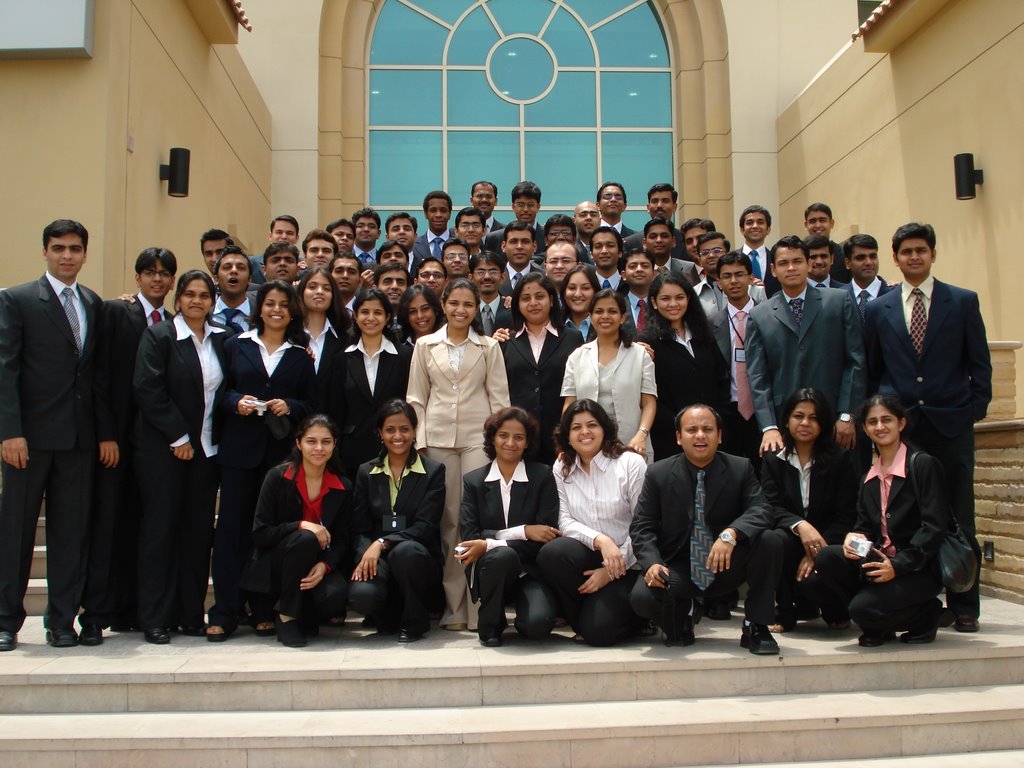
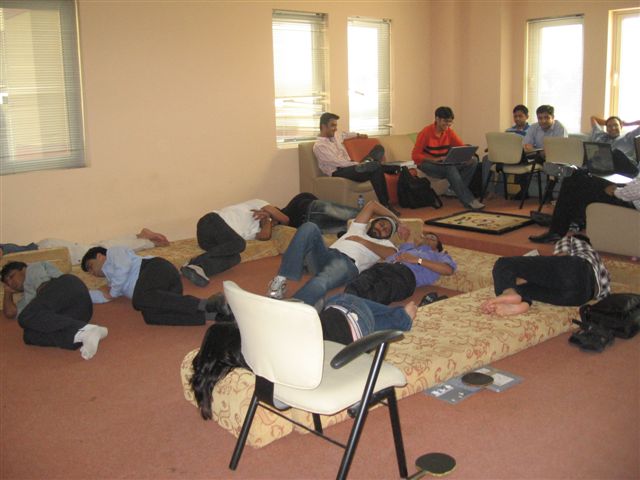
This is a video capturing some treasured moments of the Singapore stint of the batch of Dec '07.

It was made by Sourabh Agarwal and Jaydeep Hingne of the December '07 batch to welcome the batch of Jun '08 and to give them a flavour of the times to come.

Monday, August 06, 2007

Entrepreneurship at SPJCM

An exciting part of my first semester was going through the Entrepreneurship course which ran for a whole 3 months as classes for it were scheduled only on Sundays. We had a number of interesting activities that formed a part of it. A versatile and enterprising Mr. Koh Seng Choon, a successful Singaporean entrepreneur took us through it and I must say it was most delightful to interact with him. We not only got a flavour of the Chinese ways but also about their perspective of working with Indians. On the very first day of class, he brought along with him a rattan ball and a marker. He told us that he wanted all of our names to be on the ball by the end of the course. The condition to write on it was to ask him a question in class. He would answer and promptly throw the ball to the person who asked the question. At the end of the course, one lucky person was to get the ball for keeps. This was almost like an election campaign and there was quite a frenzy associated with the event. The one with the maximum number of votes was presented with it by Dr. Vijay Sethi, our Dean. Mr. Seng Choon really put his heart and soul into making the course enjoyable and we all developed a unique bond with him. He also helped some of us get projects with companies for our SGPs. One of the activities that we all did was the “I as the Business” where we each were given a topic and were asked to speak to an audience of investors asking them to invest in our business idea. The focus on brevity was important as he highlighted that in real life, we sometimes get just a minute to convince someone to grant us an appointment.
The next exercise we undertook was called “I as the Investor”. As part of this, we were all given prospectuses of a company. We were to write a one page analysis of whether or not we would invest in it and the reasons for the same. Drafting a covering letter to the management, informing them of our decision, also formed a part of this exercise. We swore not to look up details about the company on the internet or in business papers, so that we would form an independent and unbiased judgement.
The third and most important exercise was to write a business plan – we chose subjects we were passionate about and many of our latent dreams were actually penned down in detail in the form of these business plans. There were restaurants, launderettes, sports parlours and a plethora of interesting business plans. Some of us chose to do it in groups with others having similar interests. I chose to do it alone, and although it was a lot of work to do single-handedly, it was a great learning experience. Again the written plan was accompanied by a 1 min PowerPoint presentation convincing investors to buy our business idea. Mr. Seng Choon went through them in detail and gave us valuable feedback. He liked my concept and I felt satisfied that my hard work had paid off.
As part of the course, we went for two field trips – one to SATS (Singapore Airlines Terminal Services) which is the leading provider of integrated ground handling and in-flight catering services at Singapore Changi Airport and the other to an Indian restaurant in Singapore. Both experiences were enriching.
As I look back now, I realize that the course certainly helped us imbibe an entrepreneurial spirit and mindset. Becoming an entrepreneur involves great discipline and self-belief. One has to be prepared to deal with uncertainty and often, one has to undertake multiple roles.
An MBA isn’t only about getting students ready for the corporate world and to lead in established organizations but also to equip them sufficiently to be able to undertake their own ventures, be effective managers and business persons and to make a success of them.
Surely, some of us from our batch will undertake such challenges in the future and when we do, we’ll reminisce about our SPJCM days.

-by Chandrika Kanwar (batch of Dec ’06 –’07)

Sunday, July 29, 2007

“The Economies of the Middle East” From boom to bust, and back”

As a part of the ongoing ‘Guest Lecture’ series, wherein some of the most prominent and respected names of the industry encompassing several domains, are invited to the campus to share their valuable experience, knowledge and vision with the students. On 17th of July, SPJCM Dubai was graced with the presence of Dr. Tarik Yousef, a noted economist of the modern times. Our speaker, Dr. Tarik Yousef is currently the Dean of the Dubai School of Government. He received his Ph.D. in Economics from Harvard University and specializes in development economics and economic history with a particular focus on the Middle East. His research and policy experience includes working as an economist at the Middle East Department of the IMF, Visiting Professor in the Office of the Chief Economist in the Middle East and North Africa Region of the World Bank and Senior Adviser for the Millennium Project at the United Nations.

Dr. Yousef enthralled the audience and captivated the students’ think tank as he took them through the evolution, the stagnation, the development (economic) and finally the growth policy in Arab countries in the last 30 years! He started of by detailing the scenario the Arab world witnessed during the 1950s and era following it, which boasted the transition from the closed protective mindsets of authoritarian government to a more liberal outlook which slowly became instrumental in putting the Middle East economy where it is today.
Post 1950s, the economy saw the emergence of a very specific development marvel, a model centered to redistribution, invention and massive deregulation, which was consolidated over a 30-40 year period. Some reasons for the spread-out growth model may be attributed to the consistent interventions in the form of coups and espionages. Strong dictators and military dictators at that emerged, providing a sense of safety that countered an external threat, which was again over exaggerated. Another factor, more than anything else which affected the ME, Saudi Arabia and the gulf, was OIL. The availability of oil wells in the 50s – 70s catalyzed he massive flow of funds, money that one didn’t have to work for. Hence the single monarchies ran the show and won the support by delivering free healthcare, free food, medical services, infrastructure, education and taking away taxation. As the countries became more prosperous, the political gurus thought the model is delivering and no need to open up a space. On the other hand, in exchange of welfare with the other nations, they had to give up their political rights and the dictators would become more powerful, legitimate in the eyes of the population. No right to vote, no political party but people seemed quite satisfied saying “I have a job, a career, a car, my kids go to school, and I don’t have anything to worry about”.
As goes the age old saying, all good things come to an end and nothing of the bonanza of the 70s n 80s could last. Please welcome ‘1997 – The East Asian Financial Crisis’. The Middle East went from a boom to a bust. They were doing really well till now, but post 1985 till the early 21st century they not only touched the lowest trench of all times in history, they even faired worse than all countries, except from Sub Saharan Africa. Reason – OIL PRICES! Suddenly all the welfare programs become very expensive! What was needed was a recalibration of the development model. The resistance to new liberal policies was coming from the fact that this model created a lot of vested interests associated.

Just like Nehru capitalized on the strength of personality and a wide acceptance of the intellect; he also clearly defined that the country needed ‘States’. The idea came from EU and NA to develop economic prosperity and the Arab world is a by product of this intellectual potential. The 1990s – the era of private sector development, trade liberalization, economic deregulation, this in turn gave way to a new phenomena – Globalization!
But nationals in UAE don’t think of the private sector as their first job. Not because they don’t want to work, not because they’ve been programmed but because they have created societies and education systems that did nothing but employed public sector workers for a very long time! Public sector offers job security, benefits and wage increments more competitive than the private sector for all UAE nationals and complemented to this, the degree they get is a perfect for a public sector job and only that! This isn’t a religion, but the way the societies have been created and engineered if one doesn’t have an open political system and allow people to voice concerns, practice constraints and if one doesn’t have such a political process, the reform process is going to be very difficult. Unfortunately many failed to embark on the reforms as because the existing political system didn’t help any space as they thought they would become illegitimate in the eyes of their population. THIS is the story of Dubai!!

Dr. Yousef also drew upon the shifts in economic thinking right from the neo classical era to Keynesian economics when he recited the famous quote of Keynes “In the long run we are all dead.” From where we have come right from the State Controlled era where even the prices of bread that we bought was determined by the state, to the free market economy where the forces of invisible hands interact to form a price-demand-supply mechanism. Finally Dr. Yousef mentioned that the way for the future would be Knowledge Economies. Knowledge driven societies would emerge as the new parlance and would lead the crowd further into the era of globalization. The move in that direction can be witnessed with Dubai placing a strong emphasis on education, a result of which is the Knowledge Village and the Academic City. Thus we ended with the opening question that was posted to us “Dubai, from boom to bust and back?” still unanswered as only time and the macro forces would be able to tell.

It was actually an honor to be a part of this seminar, especially when an issue of such immense gravity was dealt with an equally lucid clarity and an easy transparency, such that all of us could relate to it effortlessly. Dr. Yousef’s intellect, his vision and his critic captivated the audience for over an hour. Dr. Tarikh addressed the questions and the doubts, which the students came up with at the end of his session. Here are some concluding words from and food for thought, enough to keep us ticking for quite some time now…

“The ultimate lesson form the East Asian crisis is the knowledge that a crisis would happen. The real lesson was the speed with which the countries recovered and the path of sustained prosperity that they took. That is the challenge facing Dubai; in order for Dubai to keep propelling upwards, those with skilled degrees, with high value added talent, more voice and more stakes in the system will have to exist and sustain. The key to moving ahead is through research and development and nurturing advancements and innovations across all domains. The battle for talent in Asia is intense and skilled people are going to be in high demand Not only in this part of Asia, but everywhere. Give it more space.”

By
Joydeb Mukherjee (batch of Dec ‘06-‘07)

Freshers' Party

13th July, 2007- The date should go into the history of the SPJCM- Singapore. The day saw an exciting Fresher’s Party for the junior’s given by our revered “So-Called seniors” as they modestly called themselves. The day was anything but cool for both the juniors and the seniors as the classes in the morning were running one after the other with very small intermediate breaks.
There was an “Entrepreneurship” class starting at 11 am for the juniors. Also, a special lecture was going on in some corner of the campus of which few were not even aware!! Then, all of a sudden an announcement was made in the class that a representative of a software firm-3I has come for short listing the students for the SGP. The students were absolutely not sure of what they wanted to attend or not. Also, the seniors had the regular lectures. On top of that even they had some unscheduled lectures and some campus recruitment interviews.
The life of SPJCM never fails to rock inspite of such busy schedules. Rather, the students take them in very high spirits and enjoy every bit of it. I firmly believe in what i just said and so will all the other SPJCM-ites because after all that happened, the most hectic moment was still to come namely- Fresher’s Party.
Some background about the party is required at this point of time. The fresher’s party was initially postponed for some reason (blame the ultra busy schedule here!!). Conventionally, fresher’s party should have been arranged (in a week or so) just after the juniors arrive at the college campus. But, things at SPJCM happen differently. The fresher’s had arrived before the seniors in the college awaiting for the humble and royal seniors to arrive and throw a welcome party. It happened and so the meet; but it was all restricted to “Specialization Group” meets. But Then—some noble soul came up with the brilliant idea of the fresher’s Party. And Man!! What an idea it was!! The time and venue was mailed to all of us as the day finally came.
All decked up in the party wear—some very bold and some casual, but mostly formals. The events were announced. Some had very funny but creative names. They started with an audio/video of the time they had spent in Dubai with the message as in what should be done and what not inside the campus at Dubai-SPJCM. Following which, the juniors were invited on stage for the various regions of India for performing some Skit. The groups were given some items, which they had to use in the skit. The show was absolutely fabulous!! Next came the event of “Mr/Miss SPJCM”! The people in our batch are so shy that the seniors had to pick for themselves. Few were chosen on spot by demand. This event was a very long one as it had a number of stages to go through. Each stage was very meticulously planned. There was screening in every stage and the judgement was fair enough!! In between, few performances were going on simultaneously like mimicry, dancing, singing, etc. Few of the talents were known just that day, who used to be so silent in the class. Hardly people recognised them. Even if they knew them, it was limited to only few of the friend circle. The events were not only absorbing but trying as well. There was so much of energy dissipation in the form of hue and cry. People from the back were commenting constantly on the gals and the guys making a huge effort in the process to form “Genuine Pairs”. The energy was losing fast as ever as people were shouting at the top of their voices. Somebody from the back prayed for the Dinner...as it was gracefully accepted by our seniors. The food was mind-blowing as well!! It simple showed that the seniors had taken a lot of effort to organise the most important need of life and make their juniors feel more energised for the active participation in the events. After, we resumed from the break with our belly satisfied and placid, the results of the short listed candidates were announced. There were few Challenges made to the judges, which was rightly rejected by the Company (remember the Hypothesis sum in QT??) This event went far more serious when the contestants were asked to speak for a minute on very weird topic given to them on the spot. Finally, there was a Q&A round, which would decide for beholder of the prestigious award. The decision was very fair and simple at the end and was unanimously accepted y all of us. The winner deserved that!! After all the events were over, the stage was made open for the DJ dance Party....All the guys and gals were right up there making all sorts of movements(good or bad, i leave it to the dancers), which even the best of the dancers would think of doing it!! One of our batch mates presented an audio/visual clip for our seniors as a tribute to their awesome performance!
Everybody made merry and departed to their rooms full of praise for ours seniors. We all talked about the unity among the batch mates of our seniors, which was vividly evident in the show. Back in their rooms, people discussed and compared with our batch of students. We were all inspired and fired up to do something similar, if not better for our juniors. Once again three cheers for our seniors...HIP HIP, HURRREEEYYYY , HIP HIP, HURRREEEYYYY, HIP HIP, HURRREEEYYYY!!
-by Avishek Kumar (batch of June 07-08)

Tuesday, May 15, 2007

Sentosa Island – A Sandfilled Treat – Part I

It was always at the back of my mind to visit Sentosa. But it never happened earlier. Finally I took the courage and the time off my schedule(which was in the week when we did not have any lectures) and headed off to Sentosa. Seeing Sentosa is like seeing gateway of India in Mumbai. Your visit is never complete until you see it, or I thought so. But unlike Sentosa, gateway of India doesn’t offer you a wow effect.

We took the usual Bus No. 93 to Harbour Front and then took the Tour 6 package(the only one available at 04:00pm) which included cable car round trip, underwater world, dolphin show & 4D Magix & of course Café Del Maar(which is implied).

The cable car ride is a thing to experience, for the 1st few seconds you do feel a rush of blood as you are plunged from the insides of the 15th floor of Harbour Tower into the open sky and the initial contact with mother earth gets the blood rushing down your spinal cord (just for the record I am not a person afraid of heights).

Anyways, after 6 ½ minutes we finally arrived at the one and only Sentosa island. The entrance to Sentosa(a brilliant marketing strategy) is through a convenience store that sells almost everything that a person would demand for a day well spent at a beach picnic. So invariably even if you are carrying stuff it is difficult to pass buy without lightening your wallet a bit. There are 3 lines of buses that run (blue, red & green) that take you to and from different places on the island.

Our 1st stopover was the magnificent underwater world. You arrive at a place that makes you feel that it was built to house marine life. The surroundings and the ambience give it a perfect blend to the aquatic life that it captures around. As you enter there is a huge pond which is home to some fresh water fish and gigantic turtles.
At the entrance is the touch area where you can touch fish that are swimming in a small pool of water. I was surprised that amongst many of the fish was the sting ray(the one that killed Steve Irwin – the crocodile hunter) At the beginning of it there are different types of fossils displayed as well as over fifty species of crabs. Some of the prominent ones being the spider crab that stretches to almost 2 feet(end to end). As you keep moving ahead you come to the real underwater world. This is what Sentosa is all about.

It’s an underneath walkway through a huge pool filled with fish and marine life. You stand on the travellator and it ferries you through an 83-meter long tunnel which is made up of bullet & sound proof acrylic in a semi-circular form that keeps away marine animals from the land animals (assuming that man is an animal). There is just one word to describe the experience – “Magnificent” Yes!!! That’s how I felt being there looking around on what was the largest collection of aquatic splendor that I had ever seen. Sentosa lets the ocean come to life in front of your eyes and every moment of it is breath taking. As you move through the oceanic jungle you just can’t help wonder at the sheer magnitude of living organisms that reside beneath us. Finally underwater world which houses over 2500 marine species offers immense fun & educational value.

Across different packages that are available from the reception counter perhaps underwater world is the only one which is common across all six of them and for obvious reasons. It is a place that you can’t and shouldn’t miss and any visit to Sentosa is not complete without a tour of this. All right folks, that’s it as far as the 1st part is concerned. In the 2nd part I will cover the dolphin show, 4D magix, sounds of the sea, night life @ sentosa and yes!!! The much talked about Café Del Maar. So keep reading.

-by Amit S Mehta

Monday, May 14, 2007

Selling the “Salesman”

I have been in sales for more than four years now and have worked in different environments in more than one country. It hasn’t always been an easy ride nor has it been a claim to fame. But so far I have loved the challenge and the thought of being a revenue generator for my organization. The reason I am writing this is just to share a bit of give and take of sales. Be it any company that you are working for and any product that you are selling, provided you are working in a company that works and operates in today’s world of competitiveness, what I have observed is that a Sales Culture would have the most non-humanitarian approach to its employees. I mean the way the managers drive work out of the people is almost unbelievable. Delivery is a must and should happen in all conditions. One eats, drinks and sleeps “dhanda.” Sometimes the pressure is almost suicidal. Sales is by far the most ruthless department to work for, but that is where the risk return tradeoff happens, cause it is also the most rewarding one. In my current organization without naming it an average sales guy takes home almost as much as his manager and the “stars” gets away with the package comparable to a VP(salary+incentives). But all of this certainly doesn’t come for free. First of all it’s a shameless approach. There are early morning hurdles whereby your boss takes you for a ride and by the time you are done you realize you have nothing left. There are comparisons done and if you are on the wrong side of the numbers you feel like a jack ass carrying all the load. It’s a quantitative game and the language is “numbers.” Even if you have done well you really haven’t done well. And for the performers also the euphoria doesn’t seem to last long. One months worth of “khoon” and “pasina” ends up with hearing “you could have done better.” Another feature of sales is that it starts with zero every time so no matter how much you would have cracked, next month you are back to square one. So even if you pulled up a terrific job last month you boss says, “tell me bout today cause last month is history”. The maximum burnout also happens over here. And it also has the highest employee turnover ratio. You get the feeling of being sandwiched, stuck between your boss and the client. In retail business there are daily wars to be won. Each day is a new challenge. Each month is a new puzzle. And when the pressure is on you then a client meeting is like having sex with the orgasm being the client signing “The Dotted Line”. In front of the client a salesman is like a joker who does his tricks to entertain the client. He is like a dog waiting for his cheque(bone). And all this makes sales even more exhilarating. And it uplifts the role and the value of a salesman. Its sales that drives the business. The engine that feeds revenue into the franchise. The department that justifies salaries for all others working in a support function. The Blood-Line of a corporation. So even if you have to face the wrath of your boss, or the “golibazzi” of your client or face signs like “Dogs and salesmen not allowed” you still walk away head high with the feeling of being the “money maker.” So as the new saying would go some 20 years from now “if customers are the Kings salesmen are the Emperors.”
-by Amit Mehta

Thursday, April 26, 2007

A balancing act

Its been nearly four months since our batch arrived in Singapore. Less than two months for this stint to get over and for us to head to Dubai. Time really does fly. These few months have been packed with activity- there are a lot of things one can choose to do apart from class work and making the right choices can be a balancing act.
An MBA experience has a lot to do with one's peers or batchmates. A great amount of learning comes from one's interaction with them. Our batch here is packed with enthusiasm and has spearheaded a number of new initiatives.
One of these is the 'Big Picture Series'. As part of this we meet once a week. A few persons volunteer to make a presentation on some subject or area of importance after which there is a dialogue between them and the audience and an exchange of ideas, opinions and different perspectives. The rationale behind this initiative is to think of the larger picture and to see things in perspective.
Another initiative is the establishment of a Toastmaster's Club within SPJCM. A sizeable number of students have enrolled for this to sharpen their public speaking skills and to get a forum for networking.
A fortnightly newsletter called 'Archaeopteryx- The Missing Link' covering finance, business and technology related articles has been rolled out. The team coordinating it sees it as a vehicle to bridge the gap between what is taught in class and what happens in the real world.
Our seniors left a couple of weeks back. They've been a friendly bunch and were ever willing to share their insights with us. The elections and interviews for the various committees we have in SPJCM were completed by them.
The Entrepreneurship and Networking Club has organized a few networking events already.
The importance of networking has been stated time and again by everyone who has been through the MBA experience.
Apart from the quizzes, classes, project and group work sessions everyday, there really is a lot one can do. It really depends on one's priorities and juggling between them to reach a balance.
Many of us are eagerly waiting to get over with this and begin earning and working again. But the best thing to do would be to savour each moment while we are here. I know our seniors are missing the time they spent here immensely. Nothing we've done in the past and nothing in the future can replicate this experience. So lets live it up!
-Chandrika Kanwar

Sunday, April 22, 2007

Redefining Success of MBA

Recently I finished my MBA. As I landed myself a job during the placement week at my college, I guess I didn’t do badly by the conventional Indian definition of success at B-Schools. But is getting the job at the end of the term the only criteria for success in MBA? My experience says that getting a job is just one of the important parameters, especially in the Indian context. But then, is there more to MBA than getting the job? Yes, there is. MBA as a course is an experience worth going through. A course that teaches you valua ble lessons in teamwork and interpersonal skills – something most of the courses cannot boast of. Having gone through this experience before the multitude of you aspirants of MBA, I technically become your senior. Seniors are like classics – the books that everyone appreciates but no one reads. We seniors are like those priests who preach what they themselves don’t practice. Let me share with you some such gyan atleast some of which I might not have successfully exercised but on the hindsight, I wish I had.

Soft skills courses are important - We need to change our smug ‘know-all’ attitude towards soft-skills courses and those that deal with Human Relations. The problem, according to me, is that we perceive them to be synonymous to Communication Skills. And isn’t our selection into one of the premiere B-Schools of India proof enough of our good communication skills? But it is this very haughty attitude which is our undoing, especially because communication skill is just a part of the whole and not the be-all and end-all of it.

Groups – There are two ways a group can be formed: either college decides your group or students decide their own groups. This second group is more coherent since people generally handpick the ‘apparently’ better students of the lot. But such a selection has two problems the first of which is a proverbial aphorism – “Don’t judge a book by its cover.” The second problem is that people tend to choose only those they are comfortable and friendly with. So, the friendly, humourous and fun-to-be-with people get picked up faster while those perceived as nagging, inquisitive or overly-studious recluses are left out. This precept sometimes falls flat on its face because of the second rule, “The most sincere and knowledgeable people are not often the best people to hangout with.” Students realize their fallacy when they find that people who are pompously fun-to-be-with are not the best assets in a team. Flamboyance, in most cases, ends up being antagonistic to sincerity since the people who actually work in a group are rarely high profile. It is here that the group formed from the “left-overs” who were partners more out of compulsion than choice do a better job by working silently and sincerely, as is their wont. You need truckloads of serendipity to end up with a good group where almost everyone contributes. However, it’s only human to have a black-sheep in a group of six. So think twice before forming the group. The reserved, boring, next door nerd, & not the Mr. Flamboyant, might just be the right guy who’ll save your project.

Love blooms – It is only natural that clouds part, flowers blossom, angels sing and bells ring when a guy meets a gal. Please apportion a buffer for such an eventuality. God save the groups whose members fall in love with one of the batch-mates. No amount of coaxing, rebuking or imploring can get them out of their self-imposed honeymoon for they prefer to stay in that self-denial state of romantic hangover. After some initial altercations, you’ll learn to ignore and not expect from them. The faster your accept and adapt to this change, the better for you.

I want to Top – Our Indian education system has so deeply entrenched in us the association of self-worth with the marks and ensuing recognition that we almost forget that MBA is a different ball game altogether. You’ll find people who’re crazy after marks and those who just don’t give a damn. I would say, it is dangerous to stay in either of the camp. Going too much after marks would force you to stop looking for what you like and what would you make a career from. Your view of success would simply be a short-sighted rank. We have in our batch some commendable people who’ve been toppers all through their lives. But they say, they’re here not for rank. They’re here to discover what they want out of MBA. That should be your aim. At the same time, it is dangerous to lurk at the bottom of the pyramid. You need to ensure that you don’t let your ‘lack of concern for marks’ trickle you down to the bottom. Only a fine line separates being not concerned and being careless. Make sure you don’t cross that line. Staying somewhere in the middle should keep you in good stead and help you focus on what you want to do.

Teamwork - The Indian schools and Undergraduate Institutions are partly to be blamed for laying no emphasis on teamwork. We need to inculcate the importance of teamwork in children at an impressionable age. In their quest for ‘individual’ marks and
grades, Indian students have forgotten to work for the holistic good. It is amazing what you can achieve if you don’t care who gets the credit. But in the corporate world, your progress depends on your visibility. So how effectively you balance the two contradictions will decide how far you go. We still need to ensure that we communicate to our teams that while claiming credit for something is welcome, plagiarism is not. Soft-skills, ironically, have a very important role to play here.

Presentations – No matter how tempting it is, don’t get into a quid pro quo arrangement with the class to avoid challenging questions post presentations. It is important to learn to answer critical queries without getting defensive. You should be able to achieve this easily if your focus shifts away from marks.

Zero in - Zero in on what you want to do post MBA. Every subject being taught here is a potential career for you. Find out which subject appeals to you most, irrespective of your specialization. Don’t worry if you don’t know what role to get into post mba. Most people don’t and you’ve a huge company here. But look at every subject with an eye for picking your career out of it. You may choose to focus more on the subject of your interest and delve deeper into it.

Competitions - Without fail, take part in the B-school competitions. They’re not just important for you as a person, student, businessman or a manager but also for your college. These competitions will improve the scope of your thought process if not anything else.

Hope all the future MBAs can learn from my experiences and mistakes. I note this down on this blog so the future batches of MBAs have a different set of mistakes to commit and learn from them rather than reinvent the wheel themselves.

With this article, I hand over the baton to my junior Chandrika Kanwar.

Wednesday, March 07, 2007

Either You Sell or you Don't !! There are no two ways about it !


Ah... Another refreshing Marketing experience! Kind of brought back memories from the World MBA tour held last december

The occasion was the Career 2007 expo held annually by the Education Devp Board, Govt of Singapore. Growing rapidly in size and strength every year, the CAREER Expo Series has become the Largest and Longest career and educational event in Singapore and the region. It has maintained an impressive track record over the years with increasing number of quality exhibitors and visitors at each year’s exhibition and as a full time student; yours truly got the opportunity to represent S P Jain at the exhibition.

This year there were 3 different pavilions in the education sector:
Renowned Local & Foreign Institutions and Universities (S P Jain, NUS, NTU, UNSW etc.)
The European Pavilion (Les Roches, IMI, Switzerland etc.) and
Special Interest Pavilion (the most popular being the Casino Training Institute!!:-)

It was a kind of a totally different experience for a variety of reasons.

Firstly, we had never met so many people (more than a thousand) belonging to different races, ethnicity, occupations, countries and backgrounds; all in a span of just 3 days

Second, the event gave us a wonderful opportunity to model and develop our own elevator pitch for S P Jain and I can safely assume that by Day 3 we were able to optimise the pitch to 100% effectiveness.

Third, it taught us how to focus and market to the target audience.

Forth, it taught us much needed endurance in a typical sales role. It was very tiring to stand and interact with the seemingly never ending queue of visitors... (I almost crashed out after Day 3!! :) )

Some funny incidents...

It happened a couple of times that when we tried pitching the S P Jain, 1-year Dual City MBA model to a parent, he heard me out patiently and then said... "Dude, you know what? You have just sold my own MBA degree back to me!" I was flabbergasted! "How on earth can that be!!" I wondered...
“Yeah! I am an MBA from SP Jain, Mumbai - Batch 4, 1985, now working as a MD with a leading financial institution!", came the quick, assertive reply followed by a appreciative grin. :-)

And then there was this cute Chinese girl on day 1 who came to our stall and uttered "Easpee P ee Jaineee?" I took off with my elevator pitch for the next one minute or so, she listened intently and then after I had finished my pitch, she innocently said "no Englisaa... only Chineseee.... la"
"Uh Oh!!" How I wished I vanished somewhere that very moment! "Puff...!!"

And then there were many interesting people I got a chance to work with... Nirmala Ma'm, who has got a helluva lots of enthusiasm that is utterly contagious (wow! she sold helicopters at one point in her career! How cool!!), Neethu, with whom I worked with for the World MBA tour as well, and many other including a 20-strong team of budding MBAs who just joined the S P Jain GMBA program.

I met some very famous people too... the Education Minister of Singapore, head of the EDB, an industrialist from Pune (India), a journalist from India and representatives and academics from leading universities.

We had a really good time I must say! And although our batch of 2007 is at the fag end of our mba life, I'd like to have the opportunity of an encore.


Wednesday, February 07, 2007

The Spirituality of Business

“Never talk to me about profit, Jeh, it is a dirty word,” snapped Jawaharlal Nehru, India’s first Prime Minister, at JRD Tata, India’s premier business Tycoon of the yesteryears, when the latter tried to explain that Indian public sector needed to make profits.

Business and ‘profit-making’ ideology have been the favourite ‘whipping boys’ of our society since time immemorial. While philanthropy was always admired as an epitome of altruistic virtues, business was relegated as a nadir of selfish vices.

In ‘The Wealth of Nations,’ Adam Smith, regarded as the father of Economics, says something to indirectly corroborate this thought of the society: “It is not from the benevolence of the butcher, the brewer, or the baker that we expect our dinner, but from their regard to their own interest.”

A deeper dissection of any person’s actions would reveal that the final purpose of every human action or inaction is to find happiness for himself or herself. Why does a kind hearted person help others? Why does a selfish man help himself? Why does a crook cheat? Why does a lazy person believe in inaction? Why do people fall in love? Why do people run after money? Why do businessmen hanker for profits? Whatever be the intermediate motive in the above actions or inactions, their final aim is happiness. It is in this final purpose of any action that the difference between philanthropy and business starts to dissolve.

The glaring and obvious difference between business and charity is that the overt beneficiaries of business are the owners while the same for charity is the society at large. But what misses our eyes is that for business the covert beneficiary is our society. Since happiness is the common denominator and the final aim of every action of every human being, a philanthropist becomes as much a covert beneficiary of his own act of charity as community becomes for business. And so - when both are working for their own happiness - why should a businessman be denounced and a philanthropist be eulogized? What society as a whole has failed to realize is that business and charity are not antagonistic but complementary to each other. Whether explicit or implicit, both cater to the betterment of our society in totally ‘antagonistic’ ways. Businesses directly impact the “employable” workforce through which the benefits trickle down to their families. But businesses don’t bother about the downtrodden. Charity and non-profit organizations pick them up and make them employable, from where some businesses absorb them. Consequently, both business and charity are the obverse side of the same coin. They’re like two brothers where one is ruthless in execution while the other is mild hearted and caring. But the contribution of one over the other towards the betterment of society cannot and should not be underplayed. Interesting it is to note that ‘Corporate Social Responsibility’ (CSR) is gradually blurring this difference between business and charity at the intermediate level as well.

Thomas Edison invented the electric bulb. However, had it not been for the business interest of someone, the society would not have found an efficient way of distributing it to the larger mass. History is abound with scientific inventions that changed the face of mankind. But without the able support of businessmen, inventions would never have become commodities we have so gotten used to. Ironic as it may sound, the beauty of business is its ruthlessness. If markets are left by themselves, only the most efficient and the most effective businesses – barring a few exceptions like monopoly or unscrupulous practices where government regulations become antidotes - would survive; and efficiency introduced in business processes leads to a betterment of human society in the longer run. This is where businesses start touching the spiritual chord of philanthropy: “Service to mankind is service to God.”

Philanthropy and spirituality believe in serving people irrespective of their caste, religion, race or any other form of discrimination. Business precept also commands serving the customer by turning a blind eye to any of these discriminatory factors. The essential idea behind Globalization is that businesses don’t recognize the political boundaries and divisions that countries form. A business will go and spread its roots to countries where it sees an opportunity - political rivalries notwithstanding. For example, when Nato was bombing Serbia in 1999 both sides could eat at McDonald’s during the breaks. A business knows no divides.

McKinsey’s Eric Beinhocker in a brilliant, thought-provoking book, ‘The Origin of Wealth: Evolution, Complexity and the Radical Remaking of Economics,’ states that “The economy is a marvel of complexity, yet no one designed it and no one runs it.” ‘For any living creature,’ he adds ‘the evolutional game involves obtaining resources to live long enough to procreate and rear its young. Business is humanity’s successful effort at obtaining those resources.’


Abraham Maslow’s hierarchy of Needs proposed in his 1943 paper ‘A Theory of Human Motivation’ contends that as humans satisfy basic needs, they seek to satisfy successively higher needs that occupy a set hierarchy depicted here as a pyramid consisting of five levels.
The basic concept is that the higher needs in this hierarchy come into focus once all or most of the lower level needs are satisfied. As mankind satisfies higher needs, it’ll find a need for self-actualization which is the essence of spirituality.

So successful have businesses been that much of humanity no longer has to focus on staying alive. Thanks to business, our basic existential needs are satisfied and we’re moving towards higher needs leading up to self-realization. Business is hence an indispensable cog in the wheel of human ascension up the spiritual journey.

Tuesday, December 19, 2006

Marketing Gap


This article lists my learning from Prof. Ram Kumar’s Marketing sessions and my thought extrapolations on the same. The professor left us with a few ideas and hints to provoke our thinking. This article is an attempt to finish the thought that he kindled.

Scenario 1:
How much does an average middle class person spend for the trousers and jeans he wears? Say Rs. 800 to 1000

How much does the same person spend for a shirt, T-shirt or a top? Say Rs. 500 to 700.

And how much does he/she spend on the undergarments? Hardly Rs 30.

The discrepancy is for all to see. People spend 70% of their life in their undergarments. Some people spend even more time in them; they take them off only during ablution and defecation. The undergarments are essential for our comfort and hence make the foremost contribution towards making us confident. If you doubt the confidence part then try wearing a misfit. Also, wearing a good quality undergarment prevents you from so many disorders. And yet we spend so less on them than the outer clothing we wear.

My take:
Isn’t this ‘individuality’ and ‘healthful living’ a marketing gap that undergarments companies should try to tap? Shouldn’t these companies appeal to every individual’s ‘dormant’ desire of living the life for himself or herself for a change?

Scenario 2:
On a normal day, how much time do we spend in the
washroom? 15-30 mins.
drawing room? Max 1.5 to 2 hours
Kitchen? Gender specific but say max 3-4 hours
Bedroom? Assuming a normal person sleeps for 8 hours, we spend atleast 9 hours there.

Now the critical question: which part of our house do we spend maximum on?

Undoubtedly it is the drawing room, right? We spend the most on that part of the house where we don't even spend our maximum time. Compare the money we spend on the drawing room sofa sets and their smooth velvet cushions with the amount you spend on the bedroom mattresses and pillows. Guests come and sit in the drawing room. That is the place that needs to be at its best then. Why should we spend on our bedroom where we go only to sleep? Isn’t it a stark contrast that speaks volumes of the neglect we subject ourselves to? Don’t we pay the price of this through stiff neck at best and spondylosis at worst? Isn’t this the kind of gap that furniture and mattress companies like Ikea need to tap?

My take:
As a society, we’ve evolved giving too much importance to others. We grew up getting conditioned to doing what our parents recommended and not doing what they forbid us from doing. Parents learnt those lessons from their parents and so on. But the essential basis of all those dos and don’ts has been the perspective of others towards our actions. People in our society have evolved wondering what other person in the society would think if they do this and not that. This overbearing importance given to others has forced us to undermine the importance we ideally should’ve given to ourselves. Somewhere, the huge disparity in our spending on our personal comfort through undergarments vis-à-vis the outer clothing or on our personal feel-good factor through bedroom spendings vis-à-vis those on drawing rooms is a fallout of this societal psychosis.

Scenario 3:
How much would the following people cost per month?

A good cook: Rs. 1000
A washerman: Rs. 800
A 24*7 house cleaner: Rs. 2000
A sex worker: Rs 10000
A Personal Relation manager: Rs 10,000
A 24*7 nanny: Rs 7000
A secretary to remind you of your important appointments and deadlines: Rs 6000

Now compare and contrast all these against the cost of a housewife.

My take:
Ergo, can the contribution of a housewife be considered as the sum total of all the above costs that you save? What about the intangible gain of peace of mind that comes from not having to worry about these scores of daily chores which helps you focus better on your core competence which is to become an efficient bread-winner for the family. Pardon me for the crudity of the comparison. While comparing the monetary value of house-wife is the last thing one should do, this comparison nevertheless brings out the stark contrast like none other. If only we could realize the qualitative value that a house-wife brings to our life, we would start looking up to her and give her her due rather than relegating her to a position of nonentity. The housewives themselves need to realize what they’re to the family. That would help them value their self-worth and respect what they do.

Marketing helps change people’s outlook. Certain things were never meant to be a certain way. But societal dynamics force people to make rules out of exceptions and vice-versa. There are always some innate human desires curbed under societal forces. Companies that identify such rules that conflict with the innate human spirit need to bring out and emancipate those souls hankering to break the shackle by attacking that dormant, implicit need. Companies need not go too far to innovate in terms of new products that generate newer needs. There are enough dormant needs that are curbed under the societal forces. The sooner the companies target them, the happier the society at large would be.

Friday, December 01, 2006

Welcome To Singapore !!


Well, we are in Singapore now. Here are the latest updates in a nutshell. Both the Dubai and Singapore Cohorts have now swapped campuses smoothly as per plans and are all set to begin our 2nd term in their respective 'classy' cities.

The Dubai batch landed in Singapore first on 19th November, both the batches spent time together for about 2 weeks. This was the time when we interacted personally for the 1st time and got to know the diversity in the entire Batch (we’ve a lawyer, a doctor and one from the Merchant Navy too). And then it was time for the original SPJCM Singapore batch to bid Goodbye to Singapore and fly off to Dubai for the next six months... Sounds interesting, doesn't it? Probably, no other college in the world follows this model of exchanging its own mba students across the two most vibrant economies of the world.

Before coming to Singapore, we flew back home from Dubai for a very short 14 Day break, completed our SGP formalities, met up with some friends, did some pre-departure shopping etc... and finally landed in Singapore on 19th Nov.

But hey! What else did we do after coming to S'pore? Hmm... Well just one thing that comes to our mind. Explored... explored... and just explored this tiny little but extremely well planned City State. And let us tell you; it was FUN!! The Beautiful College campus (featured above is the library building snap taken from a 6th floor Hostel apartment), VIVO city Mall, Harbor Front et all... Singapore is very much like India and its so much 'Unlike' Dubai. Even the names of some places are like India... Crawford Market, Little India, Dhobey Ghaut, Hyderabad Road and Mustafa Market to name a few.

Singapore is such a happening place. It rains a lot and yet there is always something happening all the time. We also got a chance to have very informative interactions with a lot of Students from various nationalities studying at leading Universities like NUS, NTU and they have helped us in understanding the local culture better and very quickly. Singapore feels like a home away from home. It definitely has something that makes you feel at home... that welcome feeling which you will only get in some serene Indian cities like Pune, Bangalore etc.

That's it for now... We will keep you updated.

Catchya soon!!

P.S.: Here's the link to some snaps I uploaded on Yahoo! Photos... Check 'em out.
Click here for Hemant's snaps
and here for Easwar's snaps!

Cheers!

Wednesday, November 08, 2006

The irony of Soft-Skills

Our 2006-07 batch of SP Jain is halfway through the designated one year Global MBA program. We’re done with our stint in Dubai and are taking a much needed break in India before we move on to Singapore for the second and last part of the program. Our last term was grueling to say the least and going by what our Dean Dr. Vijay Sethi says, our stay at Singapore is to beat Dubai stint by miles, for now we’ll be robbed of even the weekends that gave us a little bit of a breather in Dubai.

And what a learning it has been! Just yesterday, I was discussing with my brother, a commerce graduate, the Macroeconomic nuances of pegged and floating currency. While that might just be a fraction of the ocean that Macroeconomics is, the discussion was something I couldn’t have done without undergoing the Dubai SPJCM experience. It has been a whirlpool worth being sucked into.

However, was there anything we could’ve done differently? Was there anything that we students as a batch could’ve handled better? The answer is an unequivocal ‘yes.’ We need to change our smug ‘know-all’ attitude towards soft-skills courses and those that deal with Human Relations. The problem, according to me, is that we perceive them to be synonymous to Communication Skills. And isn’t our selection into one of the premiere B-Schools of India proof enough of our good communication skills? After-all, didn't we all take exams like CAT, GMAT, wrote case-studies and essays, underwent Group Discussions and Personal Interviews to get selected for this program? A pretty comprehensive selection procedure I’m sure all would agree. May Hell unleash its fury now on the imprudent soul that still doubts our communication skill. But it is this very haughty attitude which is our undoing, especially because communication skill is just a part of the whole and not the be-all and end-all of it.

Our program at SPJCM entails us to work in three different groups for different purposes. The first one is a special project group for which we have the liberty to choose our team within the first couple of weeks of the commencement of the program while the other two groups are preselected for us. This group is more coherent since people generally handpick the ‘apparently’ better students of the lot. But such a selection has two problems the first of which is a proverbial aphorism – “Don’t judge a book by its cover.” The second problem is that people tend to choose only those they are comfortable and friendly with. So, the friendly, humourous and fun-to-be-with people get picked up faster while those perceived to be nagging, inquisitive or overly-studious are left out. This precept sometimes falls flat on its face because of the second rule, “The most sincere and knowledgeable people are not often the best people to hangout with.” Students realize their fallacy when they find that people who are pompously fun-to-be-with are not the best assets in a team. Flamboyance, in most cases, ends up being antagonistic to sincerity since the people who actually work in a group are rarely high profile. It is here that the group formed from the “left-overs” who were partners more out of compulsion than choice do a better job by working silently and sincerely, as is their wont. The other two groups are pre-selected and hence more heterogeneous, both in terms of experience and attitude. You need truckloads of serendipity to end up with a good group where almost everyone contributes. However, it’s only human to have a black-sheep in a group of six.

All these above groups work on various assignments that have atleast one deadline per day. Every choice is a trade-off here. You can’t choose to work with one group without antagonizing another. You can’t please one without relegating the other. You can’t continue neglecting one for long lest you be seen as a worthless moron. Life, in the middle of all this, is a huge management game in itself. It is here that the Soft-Skill and Organization Behaviour courses pitch in. Every time a team member chooses to work for a different group, there is a conflict. Motivating them to work for you is no mean task. God save the groups whose members fall in love with one of the batch-mates. No amount of coaxing, rebuking or imploring can get them out of their self-imposed honeymoon for they prefer to stay in that self-denial state of romantic hangover. Then there are some who just don’t want to work. Then there are some credit-mongers who join the group when it’s time to stand on the podium. So, what do you do for them? How do you get them to work for you especially when you’re only his peer and not his boss?

These are the very issues of conflict and motivation that you face in corporate life. The B-school environment is a fantastic learning ground for such things. But in our self-righteous myth of omniscience for soft-skills, we fail to gauge its importance. Consequently, not a single group succeeded in motivating the Non-Performing Assets (famously called NPAs) of the teams. There, according to me, lies the single biggest scope of improvement for the batch.

The Indian schools and Undergraduate Institutions are partly to be blamed for laying no emphasis on teamwork. We need to inculcate the importance of teamwork in children at an impressionable age. In their quest for ‘individual’ marks and grades, Indian students have forgotten to work for the holistic good. It is amazing what you can achieve if you don’t care who gets the credit. But in the corporate world, your progress depends on your visibility. So how effectively you balance the two contradictions will decide how far you go. We still need to ensure that we communicate to our teams that while claiming credit for something is welcome, plagiarism is not. Soft-skills, ironically, have a very important role to play here.

Friday, October 13, 2006

Thinking like a Manager

The Indian IT companies may have made the world wake up and notice India but within the company circles there is mass sarcasm that does the rounds. The IT firms have made the word ‘bench’ a byword for ridicule and frustration among the employees. To a victim, it might cast his employer in bad light for lack of projects and demoralize him, making him doubt his own abilities and credentials. Is there a better way of tackling this problem? Is it possible to ameliorate the way a ‘benched’ employee might look at himself and the company? My attempt through this article is to answer this question in the affirmative.

Mr. M Hariharan, our brilliant Cost Accounting professor, discussed a consulting assignment he once worked on. The company in question was a paint manufacturing company. The business model of the company was to produce paints of different colours in bulk and then sell it to wholesalers. The manufacturer wouldn’t sell the paint to anyone needing anything less than 250 kgs of any colour. Shifting production from one colour to another needed a large setup time for cleaning the vessels, removing stains, drying them etc. So he would actually incur some cost in shifting production from one colour to another. So he chose to produce large quantities of a colour in one go rather than shift frequently from one to another.

Think of the problems with this strategy.
• It was cost centric and not customer centric
• Except for wholesalers, not many needed that huge quantity of any single colour
• This stretched inventory turnover as the stocks piled up waiting for a big order
• He lost out on a large number of smaller orders
• Piled up inventory would slowly entail reduced production
• Inflexibility delayed delivery to customer if the colour was not already available

All his problems were solved when he - following our professor’s advice – became more customer centric. He now produced lesser quantities of paints in one go, regularly shifted to different colours and bore the setup cost.

Think of the advantages of this model.
• There was always some amount of any given colour available for sale
• Even if it wasn’t, flexibility ensured that customers’ requirements were met
• Customer was now charged a premium for faster delivery which helped cover setup cost
• The size of the order didn’t matter so he could address all customers’ needs thus increasing his market size
• Inventory turnover was reduced as he was ready to take even the smaller orders

Inventory, as we just saw, is a necessary evil. It gives a cushion of serving an unexpected customer readily and yet becomes a liability once it exceeds a threshold. Crudely put, inventory is to manufacturing what human capital is to IT. The Indian IT companies have always been following a costing model of keeping a safety stock on ‘bench’ and charging the customers for this through overhead costs. Just like the safety stock, the employees on ‘bench’ are very critical to any IT company to overcome any unforeseen exigency. Consider the attrition in the Indian IT companies and this problem would appear even more bothersome. The shadow resource or ‘benched’ employee is thus a conscious choice not only of the vendor but also of the client.

Not many people could’ve taught us Marketing better than Professor Ram kumar did. An IIM Ahmedabad alumnus, he stretched the limit of our thought processes. He made us play a short game while explaining a principle in marketing. He asked us (about 65 of us) to close our eyes and then count from one to twenty individually with only one person speaking at a time. No one was allowed to speak two consecutive numbers. We’d restart if any two students spoke at the same time. With everyone’s eyes closed, no one knew who would speak next; you always felt like speaking next but something would hold you and you would keep quiet and then somebody would speak out the next number after some time. The game was very interesting and after a few days practice we could reach a score of twenty, to our own surprise, amidst cheers of disbelief. So what was the takeaway from this game? Two. First learning has nothing to do with this article and yet is a valuable learning - human beings communicate at the subconscious level. When our goal became the same and grew stronger with every failure, our collective subconsciousness inhibited all but any one person from speaking until we reached our goal. Second learning was a statement that the professor repeated every time we bungled and had to restart the counting. He used to say, “Let us start again. Be patient. Remember that those who are not speaking are contributing equally to our cause.” This was the statement that hit me hard and gave me goose bumps all through this game. I never spoke for the entire game just to experience the thrill of contributing through silence.

So what has that got to do with employees on bench? This game conveys the idea that even without a tangible contribution to the company’s cause, such employees’ contribution is no less than those making a tangible contribution.

Dr. Viktor Frankl, a psychiatrist and founder of Logotherapy and Existential Analysis, in his book “Man’s Search for Meaning,” talks of finding a meaning in any state of life, even in the most sordid ones, to help one live a better life. In the book, he cites an incident where unemployed youth who feel dejected, demoralized and worthless due to their inability to land a job are asked to volunteer for social service until they get a job. After realizing the worth of their voluntary work, these youth realize the meaning of their existence and feel a growing sense of self-worthiness which leads to happiness at best and reduction of inferiority complex at worst.

This is precisely where IT companies have failed. They’ve have failed, not because they keep employees on bench, but because they’ve not effectively communicated the ‘benched’ employee’s worth to the victim himself. This becomes all the more important when, as shown by above examples, an employee’s output is directly related to his sense of self-worthiness, which in turn is associated to the meaning he associates to any state he is in, be it productive or buffer. Keeping the employees motivated is a titanic task for Human Resource Department of any company. They can ill-afford to ignore a threat to motivation which is as glaring as keeping them on 'bench'. This idea should hence be drilled in their minds during the new joinee's orientation to make their state of mind and self-esteem impervious to 'bench.'

Friday, September 08, 2006

Who am I? - SP's SQ Initiative

I am Kamlesh Acharya. Simple, isn’t it? But am I really the name the world knows me with? I guess not. So? Am I the physical body that moves around various places on earth? Not quite. I think I’m something deeper than the body. Am I the mind? Well, may be. But at times my mind works even when I sleep; do I then say that I’m working? I guess I’m not the mind then. So am I the soul? Well, may be; may be not. While these questions always rustle in my monologues, I don’t quite know how to answer them.
On 4th Aug 2006, Prof Debasis Chatterjee from IIM Lucknow visited SP Jain and took a guest lecture on leadership. While his leadership talk was inspiring, what grabbed the students’ attention most was the high Spiritual Quotient of his speech. He spoke fluently as if reading from a book; being an author of a few books would’ve definitely helped clarify his thought process. He delivered the lecture from his heart and brought the crowd to a mesmerizing introspection through his true words, insightful speech and a high SQ’ed visage to corroborate. Throngs of students just swarmed him after the lecture got over - something I had never seen in any of the previous lectures even when the guests were equally impressive and scholarly in their domain. I believe the difference here was that Prof. Chatterjee managed to touch a chord of our dormant self somewhere and the swarm supported this thought of mine. I was a part of that crowd and a mute spectator. I saw fellow students talking to him, barely able to control tears of joy in their eyes as others simply observed him and gathered the pearls of wisdom that fell from his mouth. I was pleasantly surprised to see so many people impressed with him. Like an avid businessman looking for an opportunity, I realized that the iron is hot and waiting to be struck. So, Dhruv Patel, Kush Bohra and I invited our batch-mates to form an esoteric group of people ready to introspect and look within for answers.
A digression of thought is warranted here. Be it in business or otherwise, isn’t MBA all about finding opportunities for what you want to do and executing your plan when it can yield the most?
We roped in Prof. Mala Kapadia - our Human Resource Management professor – to lend authenticity and discipline to the group by forming some ground rules. She was more than happy to oblige. She took our first session and forced us to think deeper and introspect harder. She left us wonderstruck with her simple logical flow of thoughts.
After that session, we’ve had three session conducted by us – the students. We’ve discussed topics like ‘Demystifying God’, ‘True Knowledge’ and ‘Learnings from the Bhagwad Gita on Work.’
Through this group and our meetings, we might not know ‘who we are.’ But by sharing the knowledge with each other, we end up learning a lot from others’ thoughts. Through these sessions, we might not reach the core of true knowledge but we’ve started gnawing at its peripheries for sure.
An interesting incident to end with.
I offered to take the first session of “Who am I?” after Prof. Mala. I called my session “Demystifying God” and sent a mail across to the group. An eager beaver I met thereafter told me that he found the topic really interesting and wondered what I’m going to talk about. I told him to wait and watch. The impatient guy that he was, he told he would search for it. Before I reveal my reply, a small digression to surprise you is not uncalled for.
Our Marketing Management professor Mr. Ramkumar told us some statistical facts released by Google.
From within India, the most searched word on Google last year was ‘S**.’
From within the US, the most searched word on Google last year was ‘God.’
I told the edgy friend, ‘You can’t search God on Google.’
*************************************
P.S. One of the subjects that is setting tongues wagging at Harvard Business School is also on the same lines. Isn't it wonderful that what is taught by professors there at Harvard is a student initiative here at SP Jain? Check out.

Wednesday, August 16, 2006

Dubai Diaries


A sneak peek for the world outside into the ways of life at S P Jain Centre of Management at Dubai and Singapore and what goes behind the scenes to make it happen!!

It is now a little more than two months since we landed in Dubai (8 June 2006 to be precise). On one hand, it feels like ages for we’re going through one of the busiest phases of our lives and on the other hand it doesn’t seem to be anywhere even close to two months at all, thanks again to the rigors that ensure a steep learning curve. Time just seems to fly by at SPJCM… We’re already on our way to becoming lifetime friends, not to mention building networks. In this latest update we try to describe how a typical day is spent at the Dubai campus (the update from Singapore will follow soon).

A typical day begins at 7 AM, with classes starting as early as 8 AM. The early morning rush to get ready for college is something that deserves mention over here. Mathematically speaking, the speed of getting ready is inversely proportional to the time left for boarding the college bus. :-) The necessity of boarding the bus becomes the mother that helps us discover our hidden potential. In fact, some amongst us have become experts in the art of getting from bed to bus in five minutes flat. God bless the inventor of Deodorants! And then there are some more running to board the bus, with laptop in one hand, belt in mouth and tucking the shirt in with the other hand giving us a live lesson in multitasking that we learn outside our classes.

Classes are a completely different story though. The exhaustion and rustiness suddenly vanish into thin air as we hear of ‘surprise Pre-class Quiz.’ Post Quiz, we get to see some ‘excellent Class Participation (CP)’ which in some cases borders on Desperate CP to earn some brownie points. At this point, we must add that the faculty flown in from SP Jain Mumbai does a commendable job of teaching us and more importantly keeping us awake through their interactive sessions.

Typically classes end by 5 PM. Occasionally; however, we’ve guest lectures by industry stalwarts after the classes as a part of Visiting Wisdom Sessions. Whether external wisdom visits us or not, the professors ensure that we get wiser every single day.

Hey Wait! You thought this is it? Boy! This is just the beginning. In fact, the real fun starts now! For now comes the Herculean task of completing the pending assignments, presentations and reports due for the next day… And by the time you leave the institute to head back home (the villas), it’s already 11:30 PM. You can’t leave any later for that is the last bus. But that is just an interval in the long movie on our typical day. In the villas too, it is not abnormal to see people discussing and studying until 1.30 or later. Thereafter you crash into the bed and flake out into oblivion…

A few more such days and we hit a weekend, full of hope for recharging our batteries. Our weekend is Sunday & Monday, the two days dedicated for the Special Group Project (SGP) with companies like Microsoft, TCS, Infosys, Emirates Bank and many others.

Truly, time just seems to fly by. We’re two months old cohort and we’ve just three more months left before we end our tryst with Dubai and move on to Singapore. There is, however, much more midnight oil to be burnt before we take the break and many dunes of wakefulness to cross before we reach the oasis of sleep.

Friday, July 28, 2006

Soft Skills ...

Soft Skills kill ...
but they do not fit my bill

Two and a half term papers ...
Make my attention taper

Now brain dead ...
Today please .. please ... lessen my dread !

Tuesday, July 25, 2006

College Lectures - I never conquered

I came.
I saw.
I heard.
I slept.
They quizzed,
I wept.
-Kamlesh Acharya & Amardeep Grover Entertainment Co.

Friday, June 30, 2006

First Week at SP Jain Dubai


When dreams turn to reality, the first reaction is of disbelief. Then comes the realization that you’re experiencing what you’d always dreamt of. And yet, the feeling is mixed. The ecstasy is overruled by fear; a fear that you somehow don’t belong to the place – a fear of failure; what if you don’t prove yourself from hereon?


It’s a proud feeling to be chosen to represent some of the brighter brains and smarter people of the lot. And yet, it is a humbling feeling; humbling - for no matter how smart you’re - you always have someone smarter than you here. No matter how intelligent you’re, there is always someone more intelligent than you here. Every brain has a better half here. Every pride meets its vanquisher here. Every wit has a repartee here.

I had always dreamt of doing an MBA from a premier B-school. After quite a few years of toil and unsuccessful attempts at entrance exams, I made it to SP Jain Dubai. Having worked with IT industry for a few years, I had seen IT industry from close quarters. Through projects, products and consulting, I had seen IT vertical at the micro level. I now wanted to work at the macro level. I was sick and tired of being directed by the organization; I now wanted to direct the way the organization went.

I left my home in India on my birthday. That might not seem too emotional a farewell until you know that I was spending my first birthday in ten years with my family. As fate would have it, I just couldn’t have left a day later – or earlier – as the session was starting soon thereafter.

So here I was in Dubai; dreaming, like everyone else, and visualizing how it all is going to turn out. The next day, Sudeep Jain, my batch mate, took me to the college and then to the hostel which actually is a villa.

Then started the real nightmare. I was the first person to arrive in the by-now-infamous ‘blue’ villa. The villa was being readied for the students who were to arrive that night and the preparation were running late even for them; I arrived that afternoon. I entered the premises of the villa to a shocking sight of carpenters and labourers going about their business. If it were not for the girls accompanying me to show me the way to the villa, my entry would not have surprised many and I would’ve been mistaken for another labourer at best or would’ve had to share their load at worst. I felt like a chief guest who arrived for the function before time. After a few hours of moving around like a zombie, I got some water to drink and freshen up. By late evening a group of about forty guys arrived in the villa and it suddenly was not a bad place to be in.

But that by no means was the end of villa ‘blues’. For more than a week we had a torrid time in the restrooms. I once had to ask my roommate to pass me drinking water bottles so I could wash the soap foam after the shower had so dramatically stopped when I needed it most. Restrooms were never the reason we prayed so hard. Luckily the prayers were answered and water never played truant when I was on the closet. The sale of deodorants in the adjoining grocery had suddenly seen a spurt. But thanks to our woes, I learnt some early lessons in economics – outside of my class: The increase in sale of a commodity may not always be due to excellent strategies of companies but due to unexpected exigencies of totally unrelated societal dynamics.

Our dean Mr. Vijay Sethi had, on our first orientation day, told us – perhaps very intentionally – to look at the bigger picture and ignore the teething problems. This advice stood us in good stead, for the administration issues put a shoddy picture in the initial week but the professors at the same time were excellent to say the least. I didn’t get worked up for I wondered what my condition would be had it been the other way round.

The professors at SP Jain Dubai need a mention here. They are sincerity and commitment personified. This stands true atleast for those we’ve seen in this short span. I was talking to an alumna the day I arrived at SP Jain and she told me that the best thing about this place are the professors. And I thanked heavens. A man of knowledge is of no use if he doesn’t know how to impart knowledge. The assignments, tests and group works ensure that we keep awake till late in the night. We have pre-session tests that ensure we read our stuff so there is a better class participation. But that also means, we’re kept on tenterhooks.

The other day I asked my roommate, “How many days we’ve been together?”
We both were shocked to realize that it had been only three days since the classes started. And it looked like we hadn't slept for ages.

I was to learn another management lesson the hard way. My earlier stint here in Dubai got me in touch with a few good caterers. I approached one of them to deliver food in the campus. He charged a very reasonable Dhs 5 a meal. It so turned out that he delivered so much in one meal that we ended up sharing the meal. There was such a downpour of people taking the meal that a lot of those who paid had no meal left for them. I started supervising the distribution but to no avail. I did not take lunch for two days so others who had paid could eat. It took me three days to realize the discrepancy and solve the problem. Now the students eat a meal at Dhs 2.5 which by all means is cheaper than what we get in India. I struck a golden deal for them; the flip side of this achievement was that I became so famous for food management that I was hand-picked for food committee instead of the ones I would’ve loved to be a part of.

Just as I’m writing this article, I get a mail asking the food committee to meet. My feet just can’t get ready to move on. And I plod away wondering at my predicament…

I take refuge in the thought that God doesn’t always give you what you want, but He sure gives you what you need; and I be happy - as is my wont…

Monday, June 26, 2006

Handing over the baton

Hi all,
The new batch has arrived and this batch of 2005, which will never be succeeded as ours was the last PGDM batch, has joined the corporate world and we hope to shake it. The GMBA batch has arrived in Dubai and Singapore will be starting from the 1st of July. I would like you guys to be introduced to the new guy in charge for this blog (obviously we will be pitching in too like guest columnists). I admit we did not do well to maintain this blog. So, I hope this new batch does it and I am sure they will do it very well.

The responsibility of this blog now resides solely on the shoulders of Kamlesh Acharya, who is the first guy from the GMBADXB06 batch (ya, thats what they call the batch which is in dubai right now) who expressed an interest in running this blog, so thanks to him I did not have to find a scapegoat and thrust the responsibility on that person.

Kamlesh runs his own blog - Mind Monologues. Do visit it.

So, this is Venkatesh, PGDM A 063, batch of 2005, S P Jain Center of Management, Dubai signing off as the chief blogger for this blog. I would like to thank my batchmates who were part of this.

Ciao and here is a toast for a new beginning!!!!